How to Win With E-E-A-T When Everyone Else is Using AI
When everyone can generate content instantly, how do you stand out? The answer is E-E-A-T. This guide shows you how to build credibility, prove your expertise, and create content that actually ranks in an AI-saturated world.

When I started blogging, the formula was simple. Pick some keywords. Write an SEO article. Publish it. Make it easy to read. Add your meta descriptions.
Boom. Within a week, you'd see it rank. If your domain authority was decent, first page wasn't far off.
Those days are long gone.
Now, everyone can create satisfactory content within minutes. Thanks to AI, you can generate a 2,000-word blog post before your coffee gets cold. Add a few tweaks, update the tone—and boom, you have a "good" piece of content.
The problem? So does everyone else.
The internet isn't just saturated anymore. It's flooded with perfectly adequate, SEO-optimized pieces that all say roughly the same thing. If your strategy is still "write more, publish faster," you're already behind.
So how do you stand out? How does your content—human-written, thoughtfully crafted, maybe with a bit of AI help—rank higher than thousands of other articles competing for the same search intent?
Here's the thing: Google can't reliably distinguish between AI content and human content. But it can understand who wrote it and whether people trust it. It can see if readers are engaging, staying, sharing, coming back. It tracks whether your content gets cited, linked to, mentioned by name.
That's where your piece shines.
The E-E-A-T score of your content — rooted in your experience, backed by your expertise, validated by your authority, and built on trust — is higher than that anonymous piece floating on page three. And in 2025, that difference is what actually matters.
What E-E-A-T Actually Means in the Age of AI
E-E-A-T stands for Experience, Expertise, Authoritativeness, and Trustworthiness. It's not a direct ranking factor in the way backlinks or page speed are, but it's part of how Google's Search Quality Raters evaluate content—and those evaluations shape the algorithm.
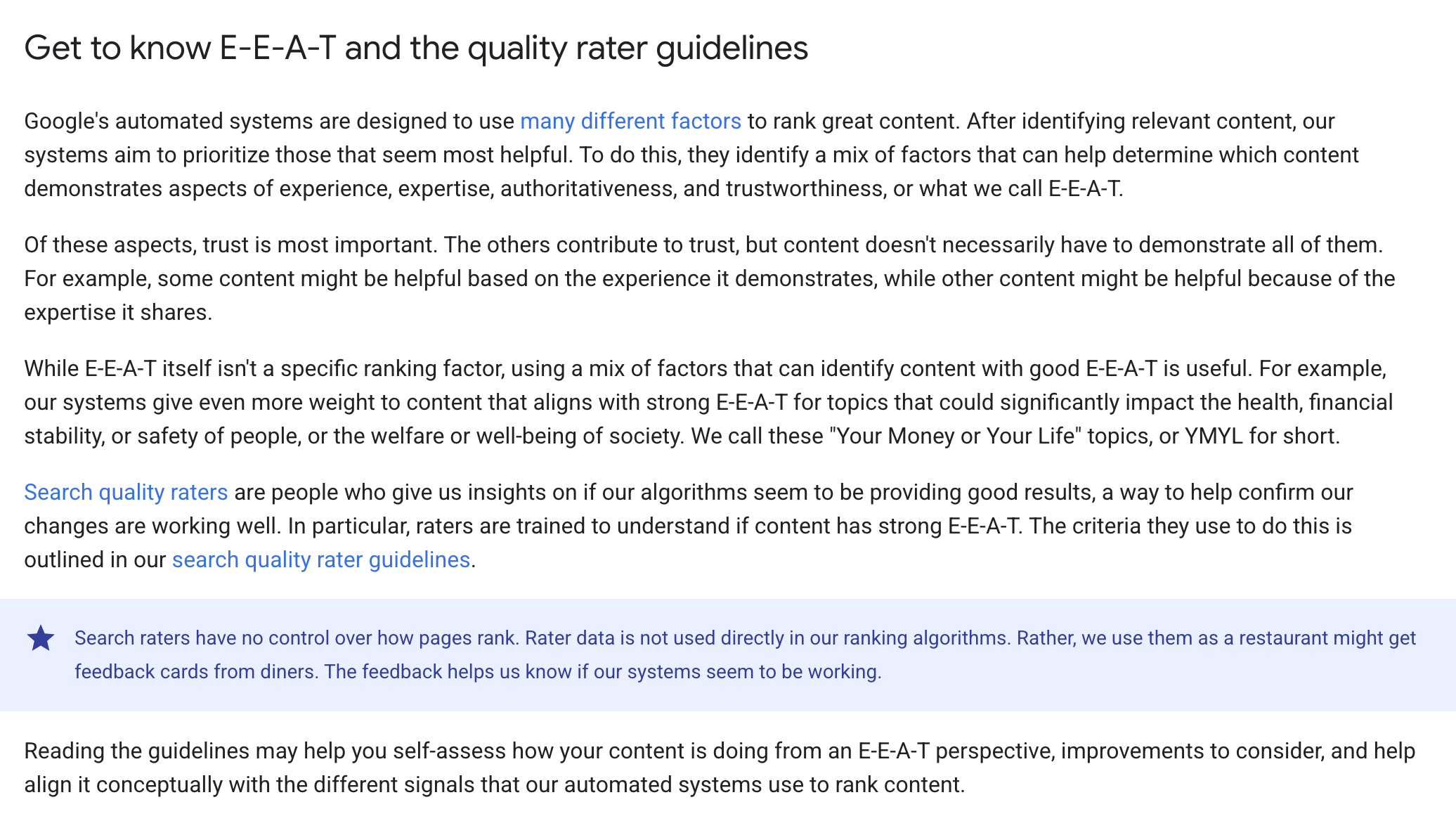
Google introduced E-E-A-T (originally E-A-T, with Experience added in 2022) because the web was filling up with content that looked credible but wasn't. Thin affiliate sites posing as product review hubs. Health advice written by freelancers with no medical background. Financial tips copied from Reddit threads and repackaged as authoritative guides.
The goal was simple: prioritize content created by people who actually know what they're talking about and have something real to prove it.
Here's what each pillar means in practice:
| Pillar | What It Means | Why It Matters Now |
|---|---|---|
| Experience | Firsthand proof that you've actually done, used, or lived what you're writing about | AI can't generate lived experience — this is your competitive edge |
| Expertise | Depth of knowledge and skill in your subject area | Needed to avoid generic, surface-level content that AI tends to produce |
| Authoritativeness | External validation — recognition from others in your field | Signals reputation beyond your own site; builds trust through third-party proof |
| Trustworthiness | Accuracy, transparency, and reliability of your content | Critical as misinformation grows and readers become more skeptical |
Why Generic AI-Written Content Struggles With E-E-A-T
AI is excellent at pattern recognition. It can analyze thousands of articles and produce something that sounds informed. But it can't do the things that actually build credibility. It has no firsthand proof — no failed campaigns to learn from, no real tests to reference. It hallucinates facts, recycles language from what already ranks, and offers no contrarian takes or original insights. Most importantly, AI has no point of view, no stake, and no accountability. It doesn't have a reputation to protect, and readers can sense that.
Compare these two approaches:
Generic AI version: "Email marketing is an effective strategy for businesses. It helps build customer relationships and drive conversions. Best practices include segmenting your audience, personalizing content, and testing subject lines."
Human-layered version: "We tested 47 subject lines last quarter and found that personalization only improved open rates when it wasn't obvious. Lines like 'Hey Sarah, quick question' performed 22% worse than '[Company name] just shipped your feature request.' Turns out, people don't want fake familiarity—they want proof you're paying attention."
The second version has proof, a point of view, and real data from a real test. That's E-E-A-T in action.
The New Content Standard: Proof-Driven Publishing
The old content playbook was volume-based. Write more. Publish faster. Cover every keyword variation. Hit your content calendar targets.
That approach doesn't work anymore — not because it's wrong, but because everyone else is doing it too. When thousands of sites can produce the same "10 Tips" article in minutes, quantity stops being a competitive advantage.
Proof isn't just data and screenshots — though those help. It's also originality. It's lived insight. It's the ability to say "here's what most people get wrong" and back it up with something real. It's showing your work, citing your sources, and being transparent about what you know and what you don't.
Google is watching for this. Not directly, but through signals that correlate with quality: how long people stay on your page, whether they bounce immediately or keep reading, if they share your content or link back to it, whether they return to your site later. These behavioral signals reveal trust gaps before Google's algorithm ever does.
If readers don't trust your content, they leave. If they leave fast enough and often enough, Google notices. And if Google notices, your rankings drop — no matter how well-optimized your meta description is.
In 2025, the sites that win aren't the ones publishing the most. They're the ones proving the most.
How to Apply E-E-A-T in an AI-Enabled Workflow
You don't have to choose between AI and credibility. The goal isn't to avoid AI—it's to use it strategically while layering in the human elements that actually build trust.
Here's a five-step framework for creating content that ranks, converts, and stands the test of algorithm updates:
Step 1: Use AI for Structure, Not Voice
AI excels at the scaffolding work: generating outlines, organizing research, identifying content gaps, and suggesting angles you hadn't considered. Let it do the heavy lifting on structure and direction.
What AI shouldn't do: write your final draft in its voice. If your content sounds like anyone could have written it, it probably won't resonate with anyone.
In practice: Use AI to draft an outline or pull together initial researchand . Then rewrite it in your voice, with your perspective, using examples only you can provide.
Step 2: Add Experience
This is where most AI-generated content fails, and where you have the biggest advantage. Experience is proof that you've lived what you're writing about.
Include:
- Screenshots from your own tools or dashboards
- Case studies from real projects (anonymized if needed)
- Failures and what you learned from them
- Actual metrics, not hypothetical ones
- User stories or customer feedback
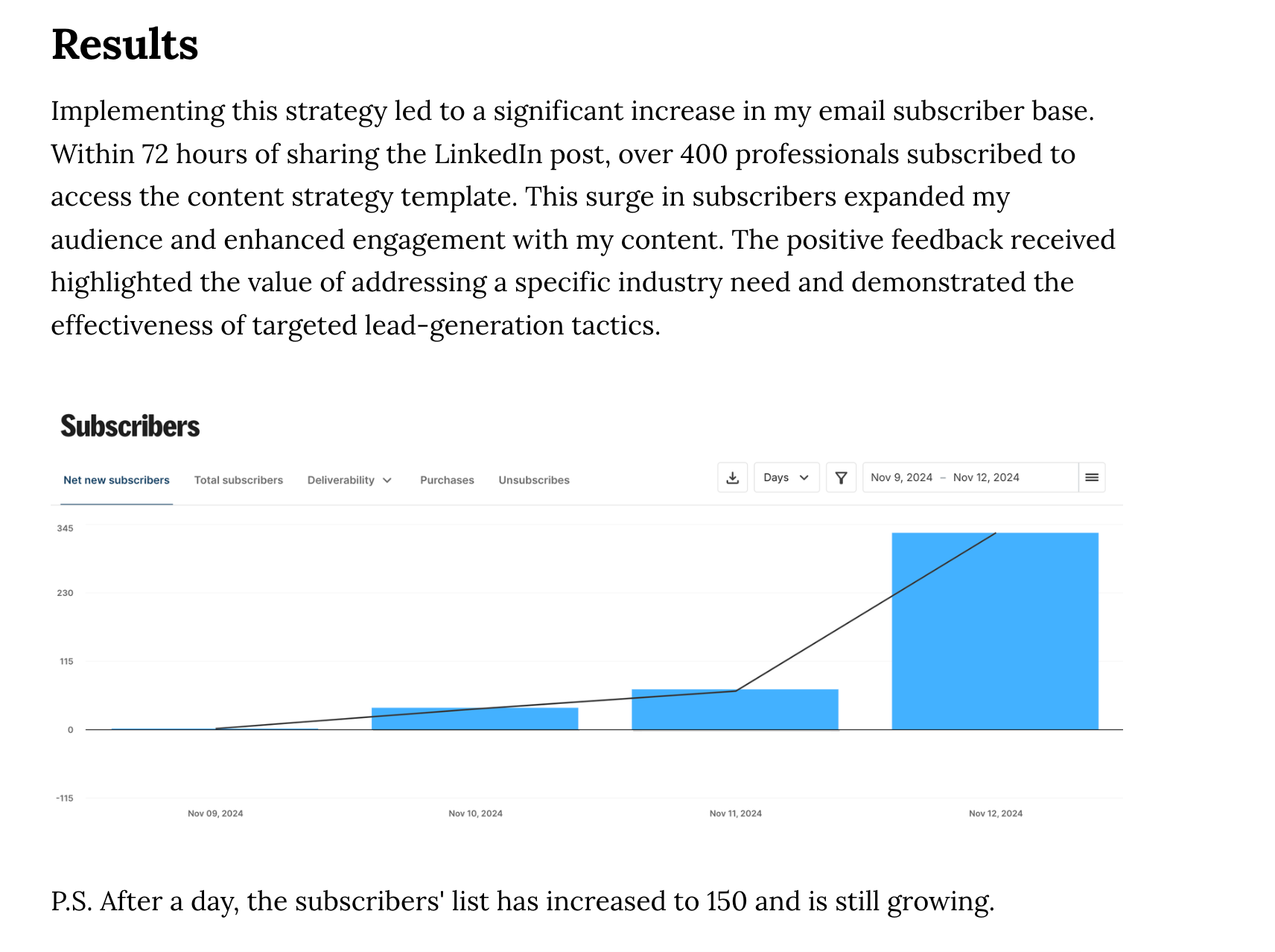
In practice: Last year, I wrote an article on how I got 400+ subscribers in three days. That post wasn't generic advice — it was based on what actually happened, how I did it, and what the results were. Readers could see the exact steps I took, the timeline, and the outcome. That's what separates content that ranks from content that gets ignored.
Step 3: Layer Expertise
Expertise is depth. It's the ability to go beyond surface-level advice and offer frameworks, nuance, or contrarian takes that show you actually understand the topic.
This looks like:
- "We tested this approach and here's what happened..."
- "Here's what most people get wrong about [topic]..."
- Original frameworks or mental models
- Explaining the "why" behind common advice
- Challenging assumptions with evidence
In practice: Take this example from Ash Read, who wrote about his LinkedIn consistency struggle on Buffer. He didn't just give generic advice — he shared his own experience and included the actual Google Sheet framework he built to track what resonated.
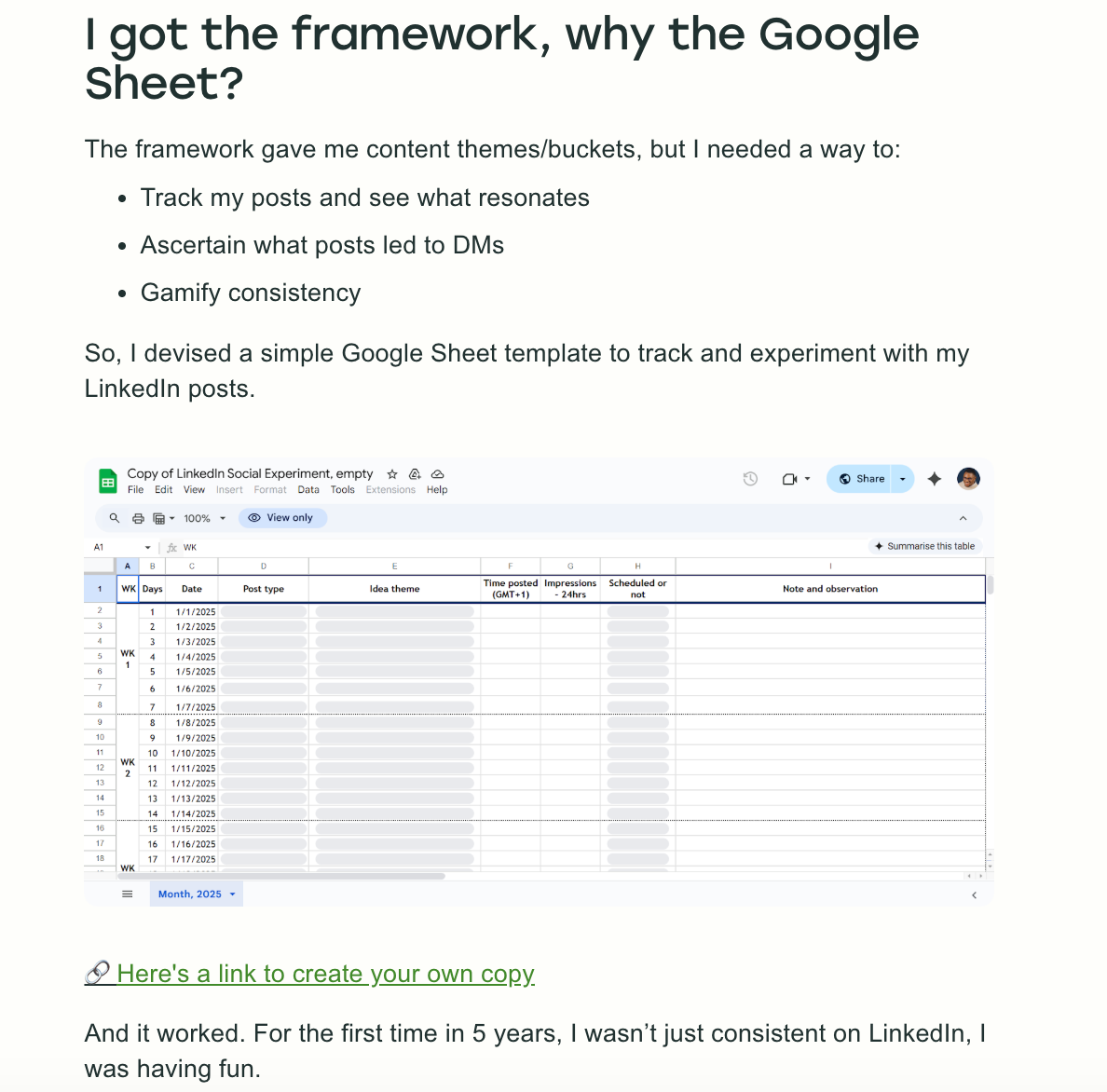
That's the kind of proof readers want. Not "use a content tracker," but here's the actual tracker, why it was built, and what changed.
Suggested read: What is Topical Authority? Your Guide to Dominating SEO
Step 4: Add Authority Signals
Authority isn't something you claim — it's something others validate. These are the external signals that tell Google (and readers) you're credible.
Include:
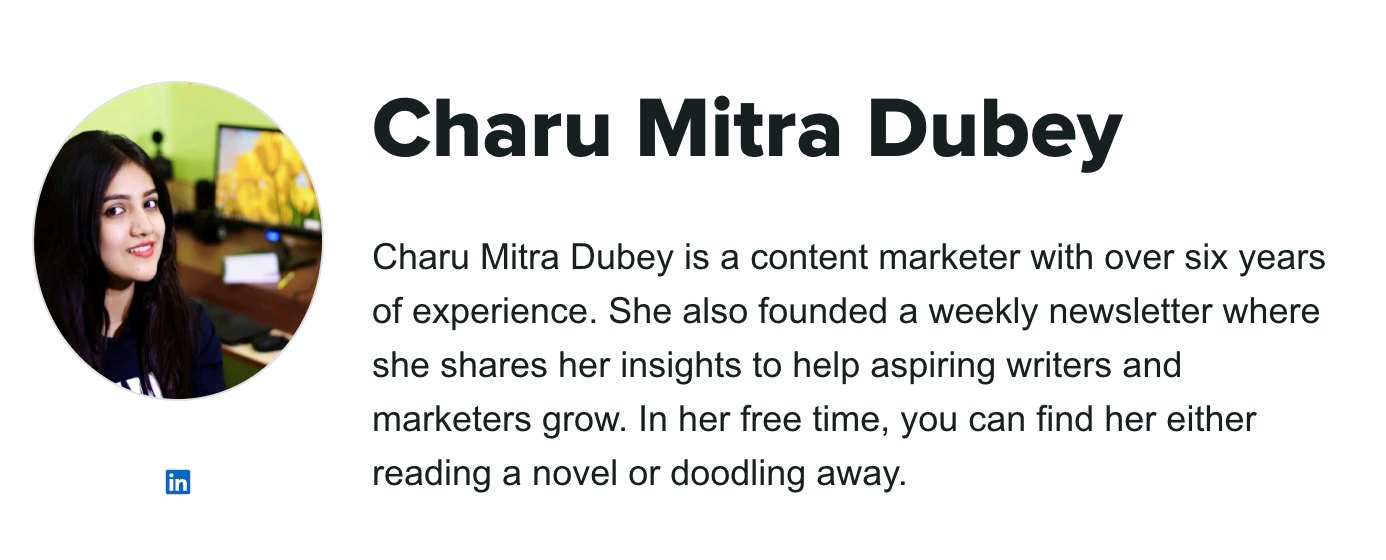
- Detailed author bios with credentials and relevant experience
- Links to credible sources (studies, data, expert quotes)
- Mentions or backlinks from authoritative sites in your niche
- Bylines on other respected publications
- Social proof (testimonials, case study results, client logos if relevant)
In practice: Every article should have a visible author bio. Link to your best work. Cite real sources, not just "studies show." If you've been featured or quoted elsewhere, mention it naturally.
Step 5: Build Trust Through Transparency
Trust is the foundation of E-E-A-T. It's built through accuracy, honesty, and clarity—and it's destroyed fast when you're vague, misleading, or wrong.
Show trust by:
- Adding update logs or "Last updated" timestamps
- Linking to your sources so readers can verify claims
- Including disclaimers when appropriate (especially for legal, medical, or financial content)
- Being honest about limitations or gaps in your knowledge
- Writing in a clear, human tone—not corporate jargon
In practice: Always display the publishing date and last updated date on your content. If you're not an expert in a specific area, involve subject matter experts to get an experienced edge — quote them, link to their work, or have them review your content. If a claim is based on your opinion rather than data, make that clear. Transparency builds credibility faster than perfection.
A Practical Checklist for E-E-A-T Content
Before you hit publish, run your content through this audit. If you can't check most of these boxes, your piece isn't ready yet.
Experience:
- Does this content demonstrate lived experience or firsthand knowledge?
- Have I included real examples, data, or case studies from my own work?
- Can readers tell that I've actually done what I'm writing about?
Expertise:
- Does this go beyond surface-level advice?
- Have I explained the "why" behind recommendations, not just the "what"?
- Does this challenge common assumptions or offer a unique perspective?
Authoritativeness:
- Is my author bio visible and credible?
- Have I cited credible sources for claims and statistics?
- Are there external signals (backlinks, mentions, bylines) that validate my expertise?
Trustworthiness:
- Are all claims backed by real evidence or clearly marked as opinion?
- Have I linked to sources so readers can verify information?
- Is the content updated and timestamped?
- Am I transparent about limitations or what I don't know?
- Is the tone honest and clear, not overly promotional or vague?
General quality check:
- Would this content exist if AI didn't exist? (If no, reconsider your approach)
- Does this provide value that readers can't get from 10 other articles on the same topic?
The Trust Advantage: Why Credibility is Your Moat
The AI content flood isn't slowing down. If anything, it's accelerating. More tools, faster outputs, better prompts. Within a year, the internet will be even more saturated than it is today.
E-E-A-T isn't a hack or a shortcut. It's not something you optimize once and forget. It's the long game — the decision to build content on a foundation of experience, expertise, authority, and trust instead of just keywords and volume.
AI is an amplifier, not a replacement. It can help you structure faster, research deeper, and publish more efficiently. But it can't give you credibility. That part is still human. That part is still you.
Google will keep evolving. Algorithms will keep shifting. But one thing won't change: people trust content that proves its value. They trust writers who show their work. They trust sites that earn authority instead of faking it.
The next competitive edge won't be publishing faster. It will be proving more. And in a world where anyone can write anything, that's the advantage that actually lasts.
FAQs-
1. Does Google penalize AI-generated content?
No. Google has explicitly stated that it doesn't penalize content based on how it was created — whether by AI or humans. What it does penalize is low-quality, unhelpful content. If your AI-generated content lacks originality, firsthand experience, or accurate information, it won't rank well—not because it's AI-written, but because it's not useful.
2. Can I improve E-E-A-T on existing content, or do I need to start from scratch?
You can absolutely improve E-E-A-T on existing content. Start by adding author bios, real examples, data from your own experience, and credible sources. Update timestamps, add "what's changed" notes, and layer in your unique perspective. You don't need to rewrite everything — just add the proof and authority signals that are missing.
3. How long does it take to see E-E-A-T improvements reflected in rankings?
It varies. Some sites see improvements within weeks, especially if they're adding clear authority signals like author bios and credible sources. Others take months, particularly if they're building authority from scratch. E-E-A-T is a long-term strategy—think months, not days.
4. Do I need to be a recognized expert to have good E-E-A-T?
Not necessarily. Experience can matter more than credentials, especially for topics where lived experience is valuable. If you've run successful campaigns, built products, or solved real problems, that counts—even if you don't have a degree or title. The key is proving what you know through real examples and transparent sharing.
5. Is E-E-A-T only important for YMYL (Your Money or Your Life) topics?
YMYL topics—health, finance, legal advice — are held to the highest E-E-A-T standards because bad information can cause real harm. But E-E-A-T matters across all topics now. Even if you're writing about productivity tools or marketing strategies, readers still want to know why they should trust you. The stakes might be lower, but the principle is the same.